

Becoming a coast guard pilot appeals to people who want more from aviation than scheduled passenger flights. The work can involve searching for missing vessels, locating people in distress, monitoring Australia’s maritime approaches and helping coordinate complex operations over remote oceans. However, Australians first need to understand an important distinction: Australia does not operate one national coast guard aviation service equivalent to the United States Coast Guard.
Instead, comparable aviation work is divided among the Australian Maritime Safety Authority, Maritime Border Command, the Australian Defence Force, state emergency services and specialist civilian aviation contractors.
From a flight-training perspective, this distinction matters. You do not normally complete a course labelled “coast guard pilot training” and then enter one standard government recruitment stream. Rather, you build professional aviation qualifications and operational experience before applying for specialised maritime surveillance, search and rescue, emergency helicopter or military aviation positions.
What is a coast guard pilot?
A coast guard pilot flies aircraft that support maritime safety, surveillance, law enforcement or search and rescue. In Australia, there is no single US-style Coast Guard pilot stream. Comparable work is performed through AMSA-contracted rescue aviation, Maritime Border Command, the Australian Defence Force and specialist civil operators.
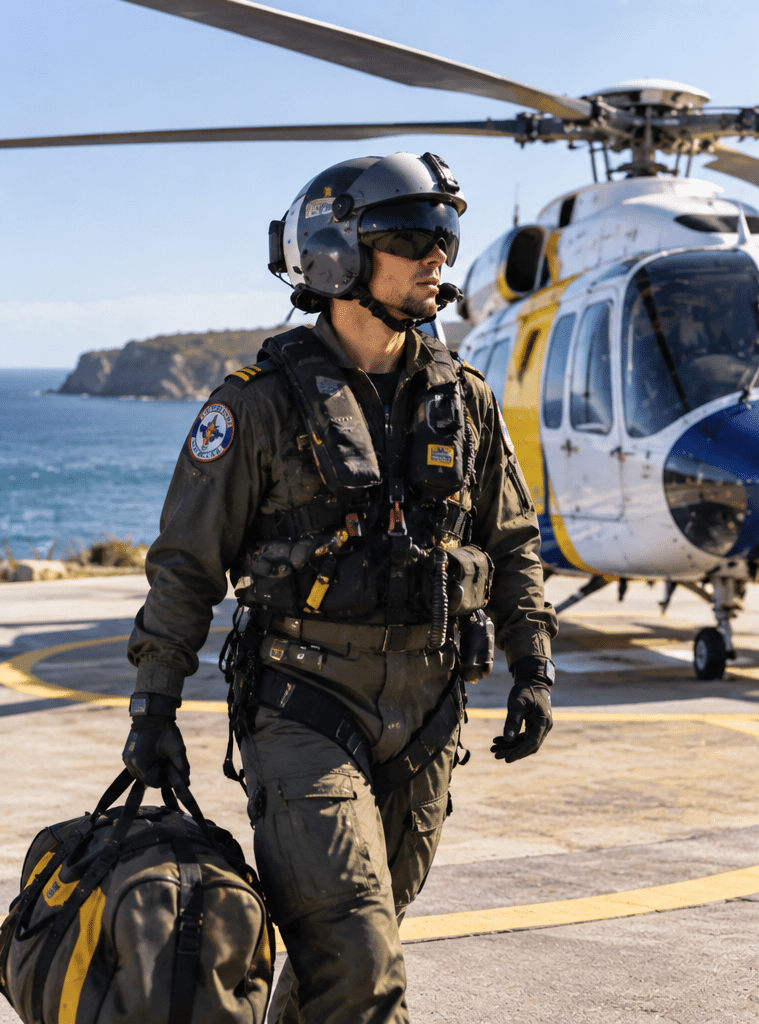
Table of Contents
- What does coast guard pilot mean in Australia?
- Who performs coast guard aviation duties in Australia?
- Coast guard pilot roles compared
- What does a maritime rescue pilot do?
- Fixed-wing versus helicopter operations
- Qualifications needed for coast guard-style flying
- A step-by-step coast guard pilot checklist
- Skills required for maritime aviation
- Civilian, government and military pathways
- Building the required flight experience
- Medical, security and administrative requirements
- Challenges and benefits of the career
- People Also Ask
- Coast guard pilot Q&A
- Conclusion
What Does Coast Guard Pilot Mean in Australia?
The term coast guard pilot is most commonly associated with countries that maintain a formally established coast guard, such as the United States. In those systems, coast guard aviators are usually military officers who fly helicopters or fixed-wing aircraft for rescue, patrol, law enforcement and national security missions.
Australia uses a different structure.
Australia’s civil maritime security operations are coordinated through Maritime Border Command. This organisation combines Australian Border Force and Australian Defence Force personnel and assets. Its purpose is to deter, detect and respond to illegal activity within Australia’s maritime domain. Its work includes aerial surveillance and maritime patrols, as explained in the official Maritime Border Command overview.
Meanwhile, national aviation and maritime search and rescue coordination is primarily undertaken by the Australian Maritime Safety Authority, commonly known as AMSA. It operates the Joint Rescue Coordination Centre in Canberra and uses dedicated contracted aircraft alongside other available aviation resources.
Therefore, an Australian searching for a coast guard pilot career may actually be interested in one of several occupations:
- Search and rescue jet pilot
- Maritime surveillance pilot
- Border protection patrol pilot
- Emergency medical helicopter pilot
- Offshore helicopter pilot
- Royal Australian Air Force maritime patrol pilot
- Royal Australian Navy helicopter pilot
- Police or emergency-service aviation pilot
- Search and rescue mission crew member
These careers share some skills. However, their recruitment systems, aircraft, licences and experience requirements differ considerably.
Who Performs Coast Guard Aviation Duties in Australia?
Australia’s maritime aviation system is distributed across government agencies, Defence and civilian contractors.
Australian Maritime Safety Authority
AMSA coordinates national maritime and aviation search and rescue through its Joint Rescue Coordination Centre. Its responsibilities cover a search and rescue region extending across Australia, remote inland areas and vast sections of the surrounding oceans.
AMSA reported responding to 253 distress incidents in 2025. It assisted 994 people and recorded 187 lives saved. Its dedicated Challenger search and rescue jets flew 1,086 hours on live operations and delivered droppable stores during 24 incidents.
AMSA currently has four Bombardier Challenger 604 special-mission jets based across Perth, Melbourne and Cairns. The aircraft are operated and maintained under contract by a specialist aviation provider rather than being flown directly by ordinary public-service employees.
You can review the agency’s operational role through the official AMSA search and rescue information.
Maritime Border Command
Maritime Border Command coordinates civil maritime security operations. It is made up of Australian Border Force and Australian Defence Force personnel and assets.
Its responsibilities include responding to prohibited imports and exports, illegal fishing, unauthorised maritime arrivals, piracy, marine pollution, biosecurity threats and unlawful activity in protected areas. Aircraft can be used to identify vessels, gather intelligence, track movements and direct ships or other response assets.
Some aircraft supporting this work are operated by contracted civilian aviation companies. Consequently, a pilot may perform coast guard-style surveillance while being employed by a commercial special-mission operator rather than directly by the Australian Border Force.
Australian Defence Force
The Australian Defence Force contributes aircraft, ships, personnel and command support to maritime security operations.
Royal Australian Air Force pilots may fly maritime patrol aircraft, while Royal Australian Navy pilots can operate helicopters from shore bases or naval vessels. Defence aviation also supports surveillance, search and rescue, disaster response and regional security operations.
However, this is a military pathway. Candidates join the Australian Defence Force as officers or aviation personnel, complete military training and accept the service commitments associated with Defence employment.
Civil search and rescue and emergency operators
Civil aviation companies also provide:
- Helicopter emergency medical services
- Offshore transport
- Winch rescue capability
- Fire and flood response
- Police aviation support
- Aerial surveillance
- Search and rescue aircraft
- Specialist government-contracted operations
These employers generally recruit pilots who already have commercial qualifications and significant experience. They do not normally train complete beginners specifically to become coast guard pilots.
Australian Volunteer Coast Guard
The Australian Volunteer Coast Guard is a marine search and rescue organisation made up of volunteers. Its services focus on rescue vessels, marine radio monitoring, vessel tracking, public training and assistance to people on the water. It is not a national military aviation branch and does not provide the standard route to becoming a professional coast guard pilot.
Australian Coast Guard Pilot Roles Compared
The following table shows the closest Australian equivalents to the overseas concept of a coast guard pilot.
| Australian pathway | Main purpose | Typical operating environment | Employment model | Likely pilot background |
| AMSA-contracted search and rescue aviation | Locate people, vessels or aircraft and deliver emergency stores | Long-range flights over land and sea | Civilian contractor supporting a government agency | Experienced multi-engine, instrument-rated professional pilot |
| Maritime Border Command surveillance | Monitor maritime activity and support border enforcement | Coastal and offshore patrol areas | ABF, ADF and contracted aviation assets | Special-mission, surveillance or military aviation experience |
| RAAF maritime patrol | Surveillance, Defence operations, maritime response and military support | Long-range domestic and international operations | Australian Defence Force officer | Military pilot trained through the RAAF |
| Navy helicopter aviation | Ship-based operations, transport, surveillance and rescue support | Coastal areas, naval vessels and offshore environments | Australian Defence Force officer | Military helicopter pilot |
| Civil rescue helicopter operations | Search, winching, medical evacuation and emergency response | Coastal, mountain, inland and offshore environments | Civilian operator under government or service contracts | Experienced commercial helicopter pilot |
| Police or emergency aviation | Law enforcement, rescue and emergency coordination | State or territory operational areas | Government agency or contracted provider | Experienced fixed-wing or helicopter pilot |
The key lesson is that “coast guard pilot” describes a mission category more accurately than a single Australian job title.
What Does a Coast Guard Pilot Do?
A coast guard pilot’s responsibilities depend on the aircraft and employer. Nevertheless, several duties appear across maritime surveillance and search and rescue operations.
Conduct search patterns
When a vessel, aircraft or person is missing, crews may receive a defined search area from a rescue coordination authority.
The pilot must fly an accurate search pattern while accounting for:
- Wind
- Visibility
- Cloud
- Fuel endurance
- Sea conditions
- Search altitude
- Aircraft limitations
- Other aircraft in the area
- The likelihood that a target has drifted
The objective is not simply to fly over the ocean and look down. Search patterns are carefully planned to maximise the probability of detecting a target.
Maintain precise aircraft control
Maritime searching may require long periods at assigned altitudes, speeds and tracks. Pilots must maintain stable flight so observers and electronic sensors can work effectively.
In some operations, the aircraft may need to descend after identifying a possible target. Therefore, pilots must constantly consider weather, terrain, cloud base, visibility and a safe route away from the area.
Coordinate the mission crew
Special-mission aircraft usually carry more than pilots. Depending on the platform, the crew may include:
- Search and rescue officers
- Mission coordinators
- Sensor operators
- Observers
- Aircrew officers
- Rescue crew
- Medical personnel
- Winch operators
- Communications specialists
A successful mission depends on clear crew resource management. Pilots must listen, communicate and adjust the flight path without losing control of the broader operational picture.
Operate advanced sensors
Maritime aircraft may carry radar, infrared cameras, direction-finding equipment, automatic identification system receivers and satellite communications.
AMSA’s Challenger aircraft, for example, have search radar, electro-optical imaging, infrared capability, visual detection technology and communications equipment for tracking vessels, aircraft and emergency beacon signals.
The pilot may not operate every sensor personally. However, the pilot needs to understand what the equipment can detect and how aircraft positioning affects its performance.
Deliver survival equipment
Some fixed-wing rescue aircraft can drop:
- Life rafts
- Radios
- Food
- Water
- Medical equipment
- Pumps
- Signalling equipment
AMSA’s Challenger aircraft have an air-operable door for delivering life-sustaining stores and communications equipment to people in distress.
This task demands accurate aircraft handling. The crew must consider altitude, speed, wind and the movement of the vessel or people below.
Support rescue vessels and helicopters
A fixed-wing coast guard pilot may locate a target but may not be able to land or recover survivors.
Instead, the aircraft can:
- Remain overhead
- Relay communications
- Direct rescue vessels
- Mark the target’s location
- Drop survival supplies
- Provide weather observations
- Coordinate with a rescue helicopter
Therefore, patience and fuel management are vital. A crew may remain involved for hours after the first sighting.
Fixed-Wing Versus Helicopter Coast Guard Pilot Work
Both fixed-wing aircraft and helicopters support maritime operations. However, the flying experience is very different.
| Factor | Fixed-wing maritime pilot | Rescue helicopter pilot |
| Primary strength | Range, endurance and speed | Hovering, winching and direct access |
| Typical tasks | Patrol, surveillance, broad-area searching and supply drops | Rescue, medical evacuation and personnel transfer |
| Common qualifications | Aeroplane CPL or ATPL, instrument rating and multi-engine experience | Helicopter CPL or ATPL, instrument skills and advanced operational experience |
| Crew structure | Pilots, mission specialists, observers and sensor operators | Pilots, aircrew officer, winch operator, rescue crew and medical personnel |
| Main challenges | Long flights, fatigue, weather and remote diversion planning | Low-level work, confined areas, obstacles, hover references and rotor effects |
| Operational outcome | Often locates, monitors and coordinates | Can directly recover or transport people |
Fixed-wing coast guard pilot operations
Fixed-wing aircraft are well suited to covering enormous search areas. They can travel quickly to remote locations and remain airborne for extended periods.
AMSA states that its Challenger aircraft can fly for up to eight hours and have a range of up to 3,800 nautical miles. These figures help explain why jets are used to reach incidents far from the Australian mainland.
However, fixed-wing pilots cannot simply stop beside a vessel. Their value comes from speed, endurance, sensors, communication and the ability to coordinate other resources.
Helicopter coast guard pilot operations
Helicopters can hover above vessels, cliffs, beaches and remote terrain. They may lower rescue personnel, winch survivors or transport patients to medical facilities.
However, helicopter rescue work involves substantial risk management. Pilots may face:
- Darkness
- Salt spray
- Poor visibility
- Strong winds
- Moving vessels
- Few visual references
- High crew workload
- Limited fuel endurance
- Obstacles near coastal landing areas
Consequently, rescue helicopter employers typically expect significant experience beyond the minimum requirement for a commercial licence.
Qualifications Needed to Become a Coast Guard Pilot
There is no single coast guard pilot licence in Australia. Civilian pilots generally progress through Civil Aviation Safety Authority qualifications.
The exact pathway depends on whether you plan to fly aeroplanes or helicopters.
Commercial pilot licence
A Commercial Pilot Licence, or CPL, allows a person to exercise commercial pilot privileges within the applicable conditions and ratings.
According to current CASA requirements, CPL applicants must:
- Be at least 18 years old
- Meet aviation English requirements
- Complete the relevant theory examinations
- Train with an approved Part 141 or Part 142 operator
- Meet minimum aeronautical experience requirements
- Pass a CPL flight test
- Complete an aviation security status check
- Meet the applicable medical requirements
CASA currently lists 150 hours of aeronautical experience for an integrated aeroplane CPL course and 200 hours for a non-integrated course. Helicopter requirements differ according to the approved training pathway and applicable experience provisions.
Candidates should confirm current requirements through the official CASA commercial pilot licence guidance.
A CPL is an entry qualification. It does not mean a pilot is immediately ready for long-range search and rescue or complex maritime surveillance.
Instrument rating
An instrument rating allows a pilot to operate under Instrument Flight Rules when appropriately qualified, current and authorised.
This capability is highly relevant because maritime missions may involve:
- Cloud
- Reduced visibility
- Night operations
- Remote airports
- Limited weather alternatives
- Long overwater sectors
- Instrument approaches
Even when a mission includes visual searching, the transit to and from the search area may require instrument procedures.
Multi-engine experience
Many long-range search and surveillance aircraft have two engines. Employers may therefore require a multi-engine class rating, instrument proficiency on multi-engine aircraft and substantial multi-engine experience.
The reason is operational resilience. Maritime pilots regularly fly far from suitable landing areas, so they must manage fuel, weather, aircraft systems and abnormal situations conservatively.
Air transport pilot licence
Senior command positions may require an Air Transport Pilot Licence, commonly called an ATPL, or progress towards one.
An ATPL represents a higher level of theory knowledge and aeronautical experience. However, holding the licence alone does not replace employer-specific requirements for command time, aircraft type experience or special-mission capability.
Aircraft type rating
Large aircraft such as a Bombardier Challenger require a type rating. This is aircraft-specific training covering:
- Systems
- Normal procedures
- Abnormal procedures
- Emergency procedures
- Performance
- Simulator training
- Flight checks
Employers normally arrange type training for selected pilots. It would be unusual for an inexperienced candidate to independently obtain a costly type rating with no realistic employment pathway.
Medical certificate
Professional aviation usually requires an appropriate CASA aviation medical certificate.
CASA states that a Class 1 medical is required to attempt the CPL flight test. Certain CPL operations may be conducted under specified Class 2 conditions, but those conditions include important operational limitations.
Anyone considering a professional aviation career should investigate medical eligibility early. It is better to identify a concern before committing substantial money to flight training.
Military qualifications
ADF pilots are trained through the military system rather than following a purely civilian career sequence.
Military selection considers areas such as:
- Officer suitability
- Aptitude
- Medical fitness
- Psychological suitability
- Security eligibility
- Academic performance
- Leadership potential
- Service requirements
Applicants should not assume that holding a civilian pilot licence guarantees entry as an ADF pilot. Civil qualifications may be useful, but candidates must still pass the military selection and training process.
Ten-Step Coast Guard Pilot Career Checklist
Use this numbered checklist to plan a realistic Australian pathway.
- Identify the mission you want.
Decide whether you are most interested in search and rescue, maritime surveillance, Defence aviation, emergency medical work or border protection. - Choose aeroplanes or helicopters.
Fixed-wing aircraft suit long-range patrol and search missions. Helicopters suit winching, recovery and direct rescue operations. - Complete an introductory flight.
A first flight can help you assess your comfort, motivation and interest before committing to a long course. - Investigate aviation medical eligibility.
Speak with an authorised aviation medical professional and review the medical standard relevant to your intended licence. - Begin structured flight training.
Progress through foundational training before working towards private and commercial privileges under the pathway recommended by your training provider. - Complete commercial theory and flight training.
Develop knowledge in navigation, meteorology, aerodynamics, flight planning, operations, human factors and aviation law. - Add relevant ratings.
Depending on your chosen sector, these may include an instrument rating, multi-engine class rating, night privileges or instructor rating. - Build professional experience.
Early work may involve flight instruction, charter, regional aviation, tourism, utility operations or other commercial roles. - Develop maritime and crew skills.
Seek experience involving multi-crew operations, remote-area flying, instrument procedures, complex aircraft and disciplined decision-making. - Apply to specialist employers or the ADF.
Compare each vacancy carefully. Required hours, command experience, security conditions and aircraft qualifications can change between employers and recruitment rounds.
Skills Required for a Coast Guard Pilot
Licences establish legal privileges. They do not automatically create operational judgement.
Special-mission employers look for pilots who can remain dependable when flights become tiring, uncertain or emotionally demanding.
Crew resource management
A coast guard pilot must work as part of a team. The most experienced captain cannot personally manage every sensor, radio call, checklist and observation.
Good crew resource management involves:
- Clear briefings
- Closed-loop communication
- Respectful challenge
- Workload sharing
- Error detection
- Situational awareness
- Calm decision-making
A pilot who refuses input from other crew members can become a safety risk.
Instrument flying discipline
Maritime weather can change quickly. Coastal cloud, rain, haze and low visibility can complicate both the search and the return flight.
Therefore, pilots need more than the ability to pass an instrument test. They need consistent scan discipline, procedure knowledge and sound judgement about when not to continue.
Fuel management
A search aircraft may need to fly to a distant area, conduct a lengthy search, divert around weather and return to a suitable airport.
Pilots must continually recalculate:
- Fuel remaining
- Search endurance
- Diversion options
- Reserve requirements
- Weather at alternative airports
- The consequences of remaining on scene longer
The pressure to help people must never override safe fuel planning.
Search awareness
Maritime targets are difficult to detect.
A life raft, overturned vessel or person in the water can be extremely small compared with the surrounding ocean. Sun glare, whitecaps, rain and sea colour further reduce visibility.
Pilots need to position the aircraft so observers and sensors receive the best possible search conditions.
Emotional control
Search and rescue flying is meaningful, but not every mission has a successful outcome.
Crews may encounter:
- Injured survivors
- Missing children or family groups
- Fatal accidents
- Long searches with no sighting
- Pressure from changing weather
- Distress communications
- Fatigue after night call-outs
Professional operators use training, crew support and structured procedures to help personnel manage these demands.
Adaptability
No two maritime missions are identical.
One flight may involve monitoring a vessel. Another may involve locating an emergency beacon, coordinating with a merchant ship or dropping survival equipment hundreds of kilometres offshore.
Pilots must apply standard procedures without becoming rigid when the operational situation changes.
Civilian Coast Guard Pilot Pathways
For many Australians, the most practical route is to qualify as a civilian commercial pilot and progressively build relevant experience.
Flight instruction
Flight instruction is a common hour-building pathway for new commercial pilots who gain the required instructor qualifications.
It helps develop:
- Communication
- Aircraft handling
- Situational awareness
- Decision-making
- Responsibility for another person
- Familiarity with varied weather and student errors
However, instruction should not be treated merely as a way to collect hours. Good instructors take responsibility for developing safe future pilots.
Charter and regional aviation
Charter and regional operations can provide exposure to:
- Commercial scheduling
- Remote airports
- Passenger operations
- Instrument procedures
- Multi-engine aircraft
- Operational control systems
- Challenging weather
- Crew coordination
This experience can be relevant to later special-mission roles.
Aerial survey and surveillance
Survey and surveillance flying may develop accurate track-keeping and coordination with specialist equipment operators.
However, not every aerial survey role is equivalent to maritime patrol. Candidates should evaluate the aircraft, procedures, safety culture and type of operational experience involved.
Offshore and utility helicopter work
Helicopter pilots may progress through instruction, tourism, utility, mustering or other sectors before becoming competitive for offshore or rescue positions.
The pathway can be long because advanced helicopter roles often require significant command time and specialised experience.
Pilots should avoid choosing unsafe or poorly supervised work simply to build hours quickly. The quality of experience matters as much as the total.
Military Coast Guard Pilot Alternatives
The RAAF and Royal Australian Navy provide some of the closest Australian equivalents to a formal military coast guard aviation career.
RAAF maritime patrol
RAAF maritime aviation can involve surveillance, reconnaissance, search support and Defence missions.
Military maritime patrol aircraft operate with a full mission crew. Pilots are responsible for safely positioning the aircraft while other specialists manage surveillance systems and mission tasks.
This pathway may suit someone who wants:
- Military service
- Structured aviation training
- Leadership responsibility
- Multi-crew aircraft
- Maritime operations
- Domestic and overseas postings
However, Defence service is not simply sponsored flight training. Members accept military discipline, operational obligations, posting requirements and minimum service commitments.
Navy helicopter aviation
Navy pilots may operate helicopters in support of ships and maritime operations.
The role may include:
- Transport
- Surveillance
- Utility flying
- Shipboard operations
- Maritime support
- Search and rescue assistance
- Defence missions
Landing a helicopter on a moving ship requires specialised training and precise crew coordination. Therefore, the pathway is demanding and highly selective.
How Much Experience Does a Coast Guard Pilot Need?
There is no universal flight-hour figure for Australian coast guard-style employment.
The minimum hours needed for a CPL are regulatory training requirements. They are not the same as the experience required by a specialist employer.
A newly qualified commercial pilot may have demonstrated the standard needed to hold a licence. However, a long-range search and rescue operator may need pilots who have already managed:
- Multi-engine aircraft
- Instrument conditions
- Commercial passengers
- Remote airports
- Night flying
- Abnormal situations
- Multi-crew procedures
- Turbine aircraft
- Operational decision-making
Individual job advertisements may specify total time, command time, multi-engine command time, turbine experience or time on a particular aircraft category.
Consequently, candidates should build a flexible career rather than waiting for one exact coast guard pilot vacancy.
Quality of experience matters
Two pilots can have the same number of hours but very different backgrounds.
For example, one pilot may have accumulated most hours in good weather near one airport. Another may have flown commercial operations across varied weather, remote regions and controlled airspace.
Special-mission employers are likely to consider the context of those hours, not just the total number.
Command experience matters
Pilot-in-command time shows that a pilot has held final responsibility for decisions.
Nevertheless, command time must also be relevant. Command experience in a simple training aircraft is useful, but it is not identical to commanding a complex multi-engine aircraft during an instrument operation.
Recency matters
Employers may look at whether a candidate’s experience is recent.
A pilot who has not flown instruments or multi-engine aircraft for several years may need refresher training, proficiency checks or renewed operational experience.
Medical, Security and Administrative Requirements
Aviation careers involve paperwork as well as flying.
Aviation security status checks
CASA includes an aviation security status check in the CPL application process. Specialist employers may also require identification checks, background screening, airport security access or government security clearances.
These are administrative and employment processes. They should not be interpreted as legal advice or a guarantee of eligibility.
Right to work and citizenship
Civilian employers may require unrestricted Australian working rights.
Certain government or Defence positions may have citizenship and security eligibility conditions. Candidates should verify the exact criteria in the current recruitment information rather than relying on old forum posts.
Anyone requiring visa or migration advice should consult official government information or an appropriately registered migration professional.
Licence currency
Pilots must maintain the applicable flight reviews, proficiency checks, medical validity, ratings and recent experience required for their operations.
A licence may remain recorded, but a pilot cannot necessarily exercise every privilege without current checks and recent experience.
Employer training
After recruitment, a coast guard pilot may complete:
- Company induction
- Aircraft type training
- Simulator sessions
- Emergency procedures
- Search-pattern training
- Maritime communications
- Crew resource management
- Sensor familiarisation
- Survival equipment training
- Supervised line flying
- Periodic proficiency checks
The employer decides when a pilot is operationally ready.
The Reality of Coast Guard Pilot Work
The career is rewarding, but it should not be romanticised.
Standby and irregular hours
Search and rescue incidents do not follow business hours.
Pilots may work:
- Overnight
- On weekends
- During public holidays
- On standby
- With little notice
- For extended duty periods within fatigue limits
A roster can provide blocks of time away from work. However, availability requirements can affect family and social plans.
Remote bases
Maritime aviation bases may be located away from a pilot’s preferred city.
Career progression can require relocation or commuting. Military personnel may also be posted according to service needs.
Repetitive patrol flying
Not every mission involves a dramatic rescue.
Surveillance pilots may spend long hours monitoring ocean areas without finding suspicious activity. Maintaining concentration during apparently routine periods is a critical professional skill.
Training and checking
Special-mission pilots are checked regularly.
Simulator assessments, emergency procedures and line checks can be demanding. Yet this recurring training is essential because crews may need to respond correctly during rare but serious situations.
Meaningful responsibility
The strongest benefit is the purpose behind the work.
A coast guard pilot may contribute to locating missing people, delivering survival equipment, protecting marine resources or supporting a coordinated emergency response.
In 2025 alone, AMSA reported assisting hundreds of people across maritime, aviation and land incidents. That figure shows why disciplined rescue aviation capability matters in Australia.
People Also Ask About Coast Guard Pilots
Does Australia have coast guard pilots?
Australia does not have one national Coast Guard aviation branch equivalent to the US Coast Guard. Similar flying is performed by AMSA-contracted operators, Maritime Border Command assets, the Australian Defence Force and civil emergency aviation providers.
Can a civilian pilot become a coast guard pilot?
Yes, civilian pilots can work in Australian search and rescue or maritime surveillance roles. However, they normally need a CPL or ATPL, relevant ratings and substantial operational experience before becoming competitive.
Do coast guard pilots fly helicopters or aeroplanes?
They can fly either. Fixed-wing aircraft are commonly used for long-range searching and surveillance, while helicopters can hover, winch people and perform direct rescue or medical transport tasks.
Is a coast guard pilot a military pilot in Australia?
Not always. Some comparable roles are military, particularly within the RAAF or Navy, while others are civilian positions with companies delivering government-contracted aviation services.
What degree do you need to become a coast guard pilot?
A university degree is not automatically required for every civilian pilot position. However, military officer pathways or particular employers may have education requirements, so candidates must review the current entry standard for their chosen organisation.
Coast Guard Pilot Q&A
1. Is an instrument rating essential for maritime search and rescue?
It is highly important for most advanced fixed-wing roles. Search missions may begin or end in poor weather, darkness or cloud, even when the actual visual search takes place in clearer conditions.
2. Should I train on aeroplanes or helicopters?
Choose based on the work you want to perform. Aeroplanes are better suited to long-range patrol and broad-area searching, while helicopters are better suited to hovering, winching and direct rescue.
3. Can I apply immediately after completing a CPL?
You may be eligible for entry-level commercial jobs, but most specialist maritime positions require additional experience. A CPL should be viewed as the beginning of professional development rather than the end.
4. Is flight instruction a useful pathway into maritime aviation?
Yes, when approached professionally. Instructing builds communication, judgement and command experience, although pilots will usually need additional instrument, multi-engine or operational experience for advanced maritime roles.
5. Are drones replacing coast guard pilots?
Uncrewed aircraft can extend surveillance coverage and reduce risk in some missions. However, crewed aircraft remain valuable for rapid deployment, complex decision-making, communication, equipment delivery and direct rescue support. Future systems are likely to combine crewed and uncrewed capabilities rather than rely on only one.
Conclusion: Starting Your Coast Guard Pilot Pathway
A coast guard pilot career in Australia does not follow one simple recruitment route. Australia distributes maritime safety, border surveillance, search and rescue and Defence responsibilities among several organisations.
Therefore, the first step is to choose the mission that interests you most.
For long-range searching and surveillance, a fixed-wing commercial or military pathway may be appropriate. For winching and direct recovery, helicopter training may be more relevant. In either case, you will need to develop licences, ratings, operational experience, medical fitness and strong crew-based decision-making.
Most importantly, focus on becoming a safe and employable professional pilot before targeting a highly specialised title. The hours and ratings matter, but judgement, discipline and teamwork ultimately determine whether a pilot can be trusted during a real emergency.
Begin by reviewing structured options to explore Australian pilot training pathways with Learn To Fly and map each stage against the current requirements of your preferred maritime aviation employer.